
OLED vs Incell vs Apple Genuine iPhone Screens: Which Is Best?
• iPhone Repair Guides
Most people assume all replacement screens are the same. In reality, two repair shops can offer a screen replacement for the same phone while using completely different screen technologies.

Written by
Braydon Stone

Apple Genuine offers the closest experience to the original factory screen.
Quality aftermarket OLED is often the best value option.
Incell is typically the cheapest option but often involves large compromises in display quality and overall user experience.

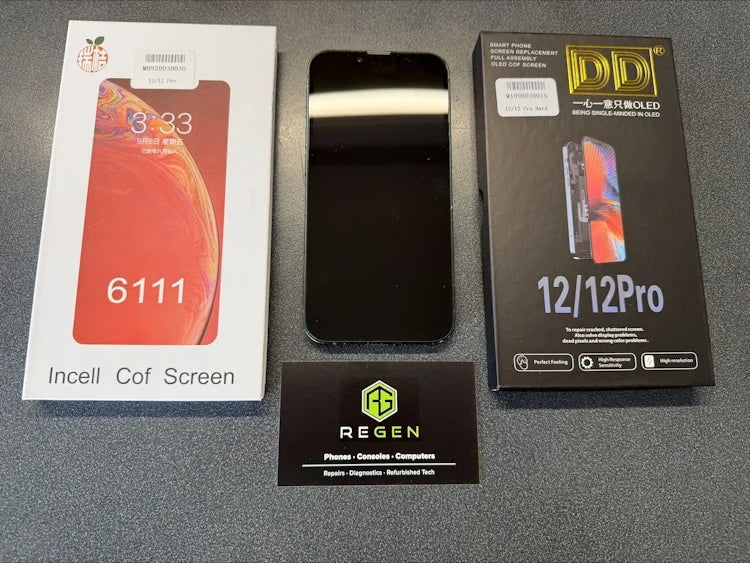
Comparison of the brightness on an aftermarket INCELL screen, Hard OLED screen and a Soft OLED screen.
Most repair shops won't tell you that the screen you're getting is not an apple genuine screen without you asking, or won't tell you the trade-offs or potential lost functionality from going with the aftermarket option, whether it be OLED or Incell. At the end of the day, there will always be a tradeoff when using an aftermarket screen vs a genuine screen, that's a large reason behind there being a significant price difference, this article covers what that difference is though and what screen is going to be right for you.

What is it?
LCD-based technology with a much lower manufacturing cost that is Commonly used as a budget screen replacement
Pros
Lower repair cost
Widely available
Cons
Lower contrast
Blacks appear grey
Potentially lower brightness
May consume more power depending on implementation
May feel less responsive
What is it?
A much higher quality aftermarket screen that doesn't use a backlight and individually lights pixels, creating deeper blacks, better contrast and often lower power consumption, particularly when displaying darker content.
Pros
Similar display technology to original screen
Better contrast
Better black levels
Better viewing angles
Typically more power efficient
Cons
Higher cost
Quality varies between suppliers
What is it?
A genuine apple screen from an apple authorized repairer is a screen sourced directly from Apple that is identical to the screen fitted when the phone was brand new. In New Zealand only Apple authorized repairers can get genuine parts from Apple.
Pros
Closest to factory performance
Full compatibility
Original calibration
Cons
Highest repair cost
Over the last several years we've fitted hundreds of replacement iPhone displays. While individual customer experiences vary, we've consistently found that warranty claims and post-repair complaints are significantly more common with budget Incell screens than with quality OLED replacements.
Since moving away from Incell replacements for OLED-based iPhones, we've seen a noticeable reduction in customer complaints related to display quality and battery performance.
Choose Incell If
Budget is your highest priority.
The phone is nearing end of life.
Choose Aftermarket OLED If
You want a similar experience to the original screen.
You want good value.
Choose Apple Genuine If
You want the closest possible match to the original device.
Cost is secondary to preserving factory specifications.
Before booking a repair, ask:
Is this screen OLED or Incell?
Does it support the original refresh rate?
Is True Tone retained?
What warranty is included?
Is the screen hard OLED or soft OLED?
What brand is the replacement screen?
Many customers assume every repair quote is based on the same screen quality. In reality, two repair shops can quote vastly different prices because they're using completely different replacement parts.
We originally offered Incell displays because they were the cheapest option available.
Over time we found that customers were significantly happier with quality OLED replacements and that they generated fewer post-repair issues and complaints.
As a result, we now recommend OLED replacements for most OLED-equipped iPhones unless a customer specifically requests a budget-focused repair.
Budget-focused
Most customers
Wants factory-original
Lowest
Medium
Highest
Lowest
High
Excellent
Varies
Generally Better
Best match to orginal
Varies
Varies
Full
Budget option
Best balance
Premium option
Many customers assume all OLED screens are the same, but there are actually different grades of aftermarket OLED replacements.
Hard OLED
Pros:
Lower cost
Better picture quality than Incell
Cons:
More brittle
Usually slightly thicker
May have larger bezels
Soft OLED
Pros:
Closest match to the original Apple display
More durable
Better flexibility
Typically offers the best overall experience
Cons:
Higher repair cost
Our Experience
In our workshop, Soft OLED screens have consistently produced the best customer feedback and the lowest rate of display-related complaints among aftermarket options.
You may be better suited to an Apple Authorised Repair Provider if:
Maintaining factory originality is important.
You want every feature preserved exactly as Apple intended.
Cost is less important than preserving original specifications.
Incell
OLED
Apple Genuine
Lowest
Mid-Range
Higher
Highest
Many repair quotes are for completely different screen technologies.
One repair shop may quote an OLED replacement while another quotes an Incell screen for the same phone.
To the customer both are simply described as a "screen replacement", but the display quality, responsiveness, battery performance and overall experience can be very different.
Before agreeing to a repair, always ask:
Is the replacement screen OLED or Incell?
Is it Hard OLED or Soft OLED?
Does it support the original refresh rate?
What warranty is included?
Will True Tone functionality be retained?
Factors include:
Screen quality
Warranty support
Technician experience
Time spent testing
Quality-control procedures
A customer brought us an iPhone that had previously received a budget Incell screen replacement.
The customer reported:
Poor outdoor visibility
Reduced battery life
Display quality noticeably different from the original screen
After replacing the display with a quality OLED panel, the customer reported a substantially better viewing experience and improved battery performance.
Individual experiences vary, but this reflects the most common reasons customers choose to upgrade from Incell to OLED.
As a general rule:
As a general rule, most standard iPhone 11 and older models used LCD displays, while most iPhone 12 and newer models use OLED displays.
This is important because replacing an OLED display with a lower-cost LCD (Incell) screen can result in noticeable differences in display quality, contrast, black levels, and potentially battery performance.
Note: There are some exceptions within older iPhone generations, such as the iPhone X, XS, XS Max, and 11 Pro series, which originally came with OLED displays. However, for most customers, the easiest way to remember it is:
iPhone 11 and below = usually LCD iPhone 12 and newer = usually OLED
Your Most Common iPhone Screen replacement Questions Answered
It can, depending on the screen's design and quality. Battery impact varies between manufacturers and device models.
Generally not identical, but quality OLED replacements can provide an experience that is very close for many users.
In some cases, yes. This depends on the repair process, device model, and screen used.
Repair pricing often reflects differences in screen quality, testing procedures, warranty support, and technician expertise.
Often yes. Common signs include lower brightness, reduced contrast, and colours that look different from the original display.
For older devices nearing the end of their life, a budget screen replacement can make sense. For newer OLED-equipped iPhones, many users prefer an OLED replacement because it preserves more of the original user experience.
Get Your iPhone Fixed Today!
Visit us in-store or book your repair online now to get started.
Book Your Repair Now